Strategy & Operations Samples

QA/Review Process Overhaul

Upon joining The Trevor Project's Training team as one of two new eLearning developers, our first major assignment was delivering the Lifeline Crisis Team's four-course training program in Litmos LMS. The project was past deadline; thus, an all-hands QA team of volunteers from across the organization performed QA on content as eLearning developers uploaded it to the LMS. The QA was highly disorganized: 30+ reviewers and their QA assignments were listed by their leads in a single Google Sheet, many without being notified. Vague assignments and disabling sort/filter on the Google Sheet resulted in many duplicate/redundant edits and major content revisions, duplicates, and minor grammar fixes being mixed together. This resulted in 1,600+ rows of edits that the eDevs had to address row by row. Each eDev made 800+ corrections while simultaneously developing new content in a highly inefficient, four-week QA.

Problem: Lack of Workflow

Post-QA feedback and our Team's experience made it clear a more efficient, streamlined QA strategy was urgently needed, as a similar project, the Digital Crisis Team's four-course training program development and delivery, was starting the next week. To overhaul the current process, we needed a structured workflow between the Training and QA teams, with clear starts and stops to edit cycles to prevent scope creep, in which major content revisions were prioritized.
QA Review Process Flowchart

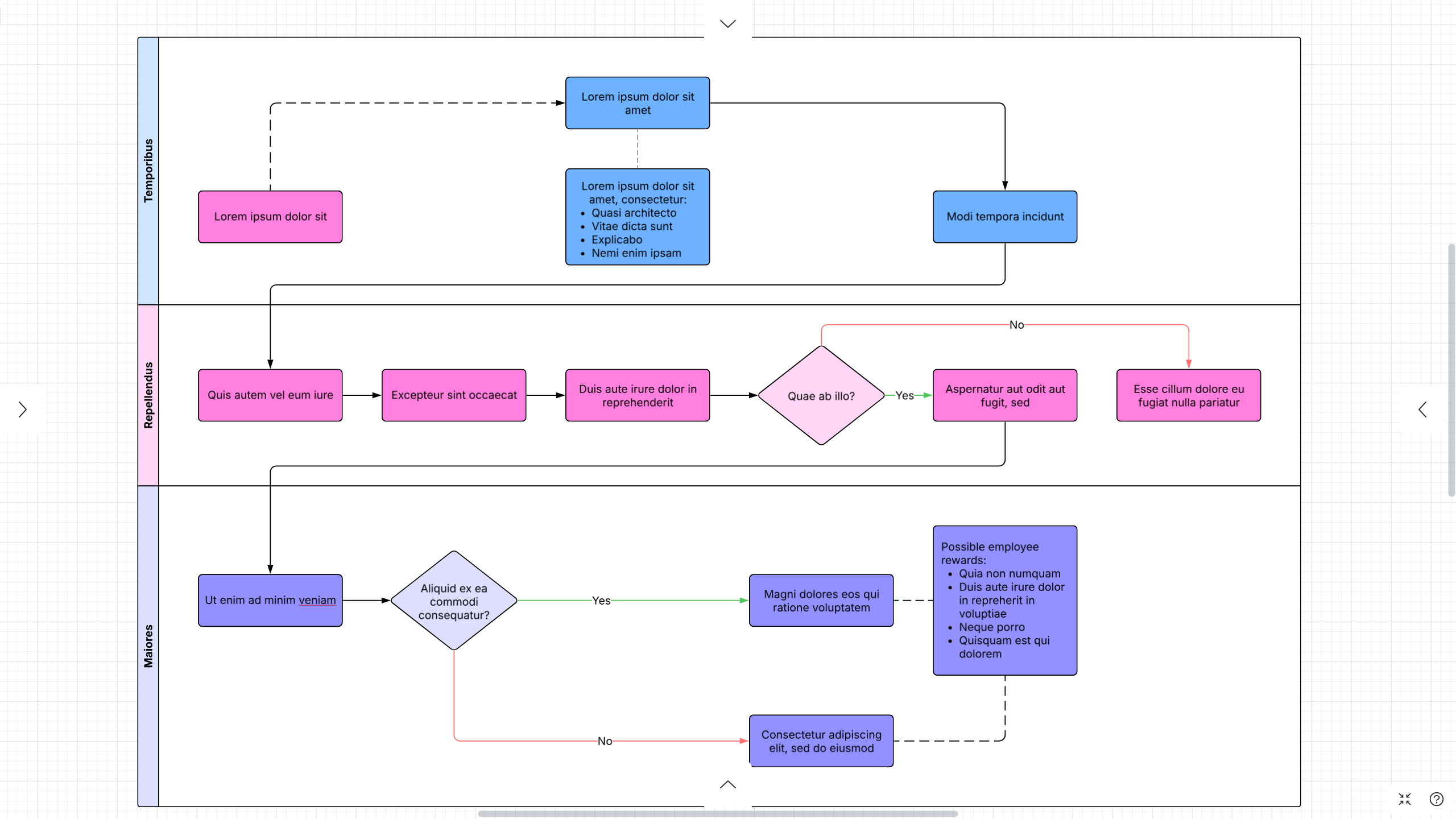
QA/Review Process Flowchart

This four-phase workflow sequences Internal Training Team tasks (blue) and External QA Team tasks (purple) per role in one process map. In Phase 1, stakeholders commented on major issues in Review360 and shared CSVs. Training resolved all major edits before uploading to Litmos in Phase 2. The QA in Phase 3 assigned reviewers to minor navigation errors, missing assets, and typos in the LMS content. Export points (red-outlined steps) marked where documentation was exported at each phase-end to aggregate into an end-of-project "source of truth" Google Sheet in the last phase.

View Full Process Document

Problem: Communicating Assignments & Tracking Edits

Training and QA teams needed a simple, shared tracking tool where Training created detailed, step-by-step QA assignments, team leads assigned these to reviewers, and Training could notify the assigned reviewers 1-2 weeks before the Phase 3 QA. For Training team members, we needed the ability to rapidly sort and prioritize edits so we could assign an ID or eDev to efficiently complete the revision.

QA Tracker Spreadsheet

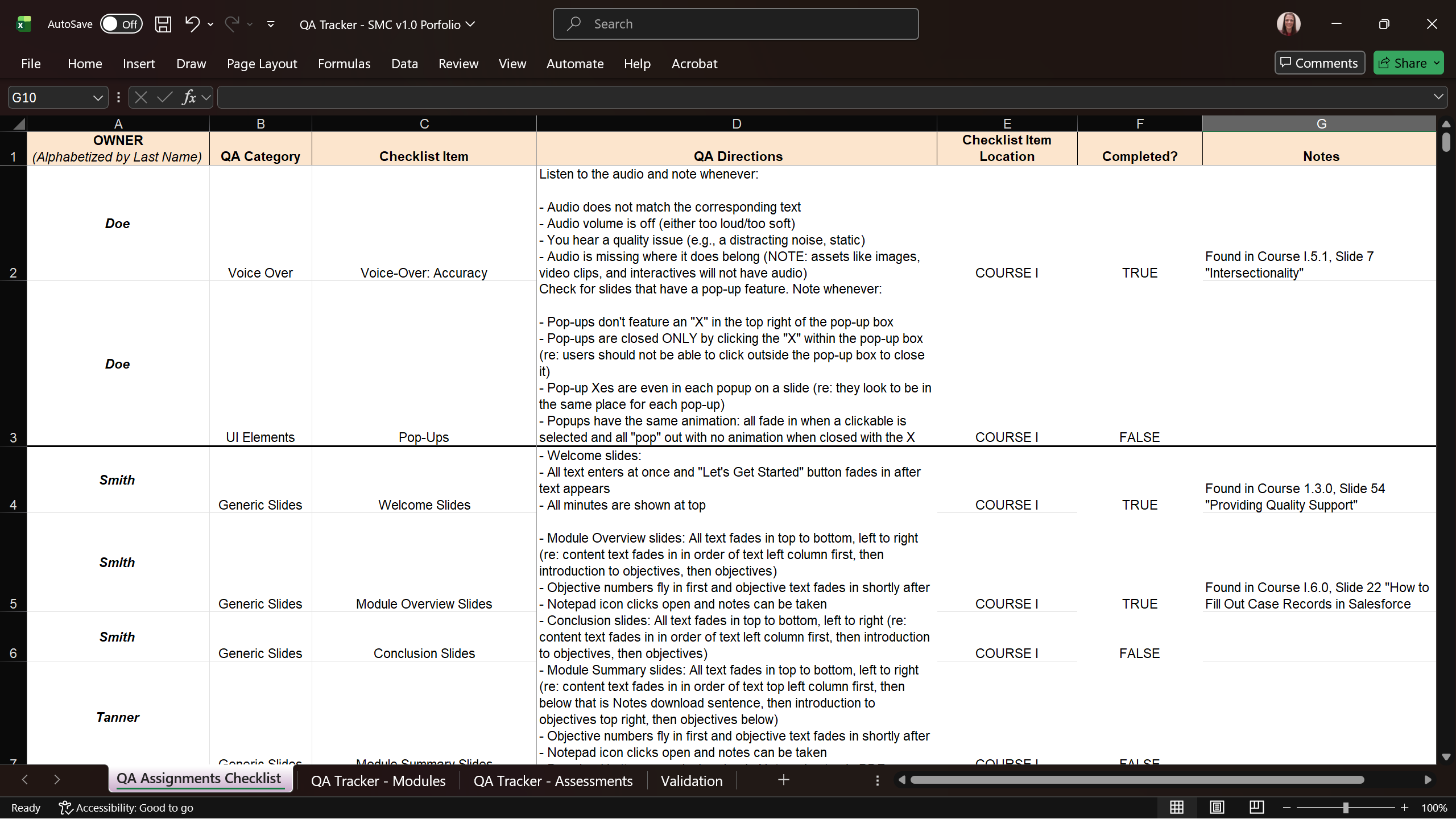
QA Tracker - Assignment & Validation System

The QA Tracker was built in a shared Google Sheet using color-coded, permission-restricted columns: the module QA and assessment QA sheets contained purple columns for reviewer inputs and blue columns restricted to Training team inputs. A validation sheet created dropdown menus so reviewers could select their name, asset category, and the exact slide or question number needing the revision they described in the Issue column. This enabled the eDevs to rapidly complete edits and set the revision status to 'Ready for Review,' which sent an automated email notification to the ID manager to confirm the edit was complete.

The linked Google Sheet shows the blank QA Tracker template with names and data removed for privacy and compliance.

View QA Tracker

Problem: Project Completion & Accountability

For team and individual accountability, our Training team needed to export and aggregate documentation from the end of Phase 1 and Phase 3 revision cycles to create one "source of truth" document showing Training 100% completed all major stakeholder revisions and minor QA edits. Since all documentation exported to CSV format, we could compile the data into a shared Google Sheet for the end-of-project "source of truth" document.

Source Documentation

Source Documentation - Complete Revision Tracking

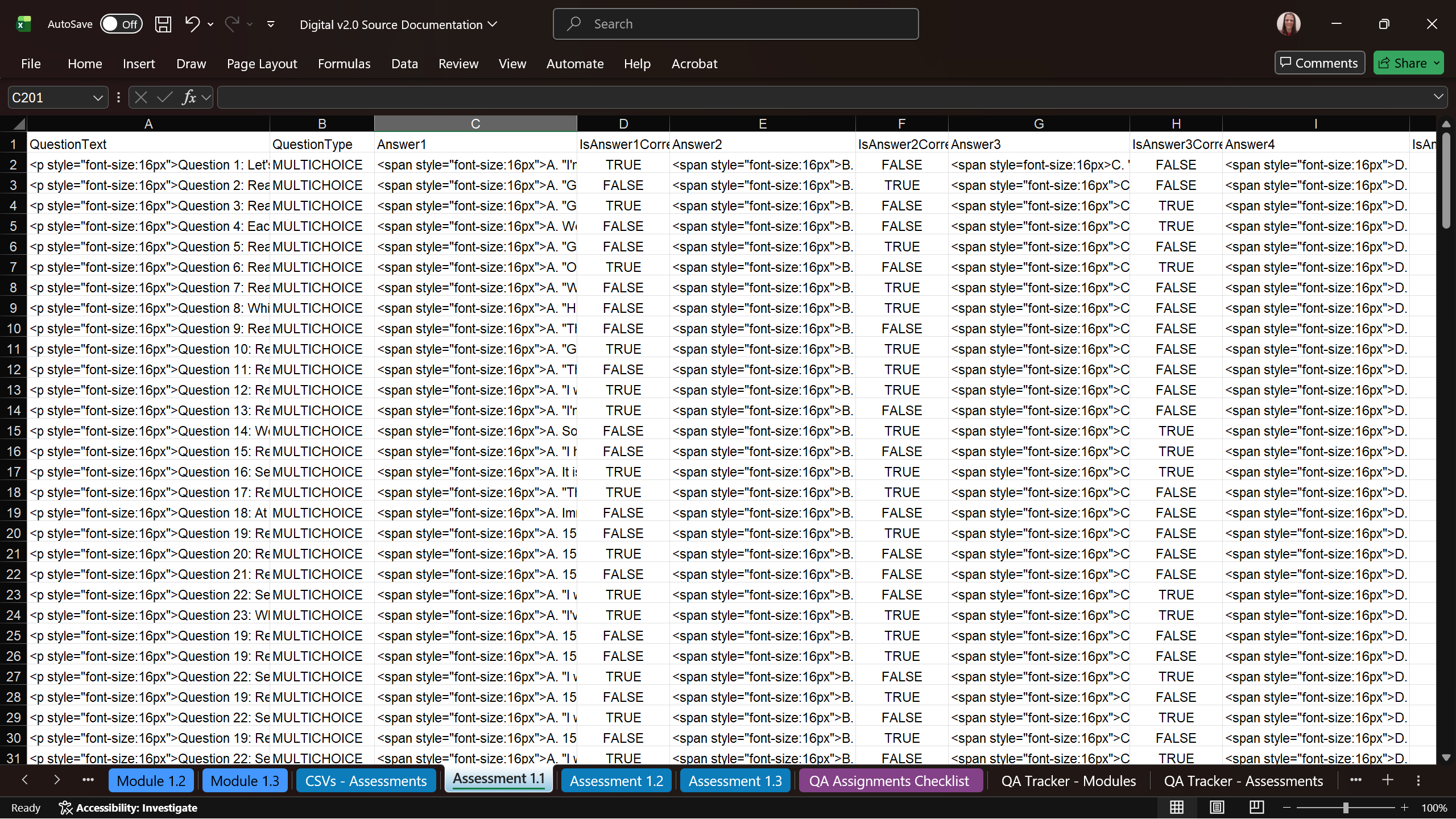
The "single source of truth" (SSoT) document was created by compiling read-only copies and exports of Phase 1 and Phase 3 documentation into one shared Google Sheet. Phase 1 documentation containing stakeholder comments with major content edits and Training's documented resolutions for each of the four courses was exported from Review 360 and saved in read-only copies of the CSV assessments then added as individual Sheets to the SSoT document. Phase 3 documentation consisting of read-only copies of the module and assessment QA Trackers with all minor QA reviewer edits and Training's solutions was also added as individual Sheets. An Asana project export from the QA team leads completed the record, creating a cross-functional confirmation that all revisions were 100% complete and the Digital training program was ready for release.

The linked Google Sheet contains original project data in the Contents, Module 1.1, Assessment 1.1, QA Assignments Checklist, and Validation Sheets. Blank Sheet templates are included to show other data records in the SSoT document. Names and data removed for privacy and compliance.

View Source Documentation

Results & Impact

The Training team first implemented the new QA process on the Digital Crisis Team's four-course training program, which began development the week after Lifeline's release. Major Lifeline content edits had been ongoing for over a year, missing multiple release dates, and culminated in an unstructured, chaotic four-week QA. Implementing the new QA process enabled Training to complete all major Digital content edits in the first week of Phase 1. After communication failures resulted in many Lifeline QA reviewers being unaware they had QA assignments, Training communicated QA assignments to leads and reviewers 3-5 days prior to start of Phase 3 QA. Structured workflows, detailed QA assignments, and using Google Sheets as edits trackers significantly increased process efficiency by reducing the QA timeline in Phase 3 from four weeks to 1-2 days.

All major content revisions from stakeholders, minor QA edits from reviewers, and the Training team's completed revisions were tracked using shared spreadsheets and confirmed complete by final edit checks performed by the ID Manager. At the end of each edit cycle, documentation of the revisions and Training's resolutions were exported or copied to one shared Google Sheet. By creating this one shared spreadsheet, our team introduced the Trevor Project's first single source of truth (SSoT) document as a cross-functional receipt confirming 100% project completion and available org-wide.